
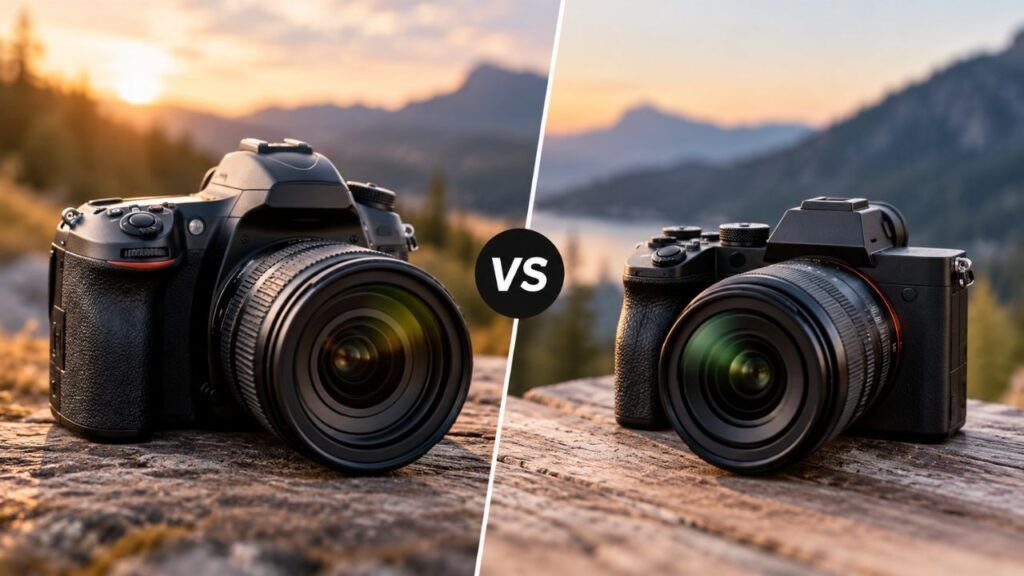
A DSLR uses a mechanical mirror and optical viewfinder. A mirrorless camera sends light directly to its digital image sensor. That basic design difference affects autofocus, size, shooting speed, battery life, video, and how you see your photo before pressing the shutter.
Both camera types can produce excellent photographs in the right hands. This guide compares their important differences and helps you decide which system better matches your photography needs.
Key Takeaways
- DSLRs use a mirror system and an optical viewfinder.
- Mirrorless cameras send light directly onto their imaging sensor.
- Both systems can deliver excellent professional-quality image quality.
- Mirrorless cameras generally provide more advanced subject-tracking autofocus.
- DSLRs usually provide considerably longer battery life per charge.
- Mirrorless bodies are often smaller, but lenses still add weight.
- Used DSLRs can provide excellent value for budget photographers.
- Mirrorless generally makes more sense for most new buyers today.
DSLR vs Mirrorless: Quick Comparison
Both camera systems share many important features and interchangeable lenses. However, their internal designs create several meaningful differences during everyday photography.
| Feature | DSLR | Mirrorless | Practical Difference |
| Internal design | Uses mechanical mirror | No reflex mirror | Changes size, speed, and viewing |
| Viewfinder | Optical viewfinder | Electronic viewfinder | Mirrorless previews exposure digitally |
| Body size | Usually larger | Usually smaller | Mirrorless can travel more easily |
| Autofocus | Very capable | Advanced subject tracking | Mirrorless generally leads today |
| Burst shooting | Usually slower | Often faster | Helpful for sports and wildlife |
| Image quality | Excellent | Excellent | Sensor and lens matter more |
| Stabilization | Often lens-based | IBIS common on many models | Depends heavily on model |
| Video | Capable | Usually more advanced | Mirrorless suits hybrid creators |
| Battery life | Usually longer | Usually shorter | EVF and sensor consume power |
| Lenses | Huge legacy selection | Growing modern selection | DSLR glass is often cheaper used |
| Silent shooting | Limited | Common | Useful for wildlife and events |
| Used value | Often excellent | Usually higher priced | DSLR can save substantial money |
The table shows the overall pattern, but model differences still matter. A high-end DSLR can outperform an inexpensive mirrorless camera in several areas.
What Is a DSLR Camera?
A DSLR is a Digital Single-Lens Reflex camera. Its defining feature is the mechanical mirror positioned inside the camera body.
Light enters through the attached lens and reaches that mirror. The mirror redirects the light upward toward the optical viewfinder.
That arrangement lets you look directly through the camera’s lens. You are essentially seeing the actual scene through an optical path.
Press the shutter button, and the mirror quickly flips upward. Light then reaches the digital sensor, allowing the photograph to be recorded.
Afterward, the mirror returns to its original position automatically.
This system has worked extremely well for professional photography for decades. It remains reliable, responsive, and familiar to many photographers.
However, fitting the mirror assembly inside requires additional physical space. That contributes to the generally larger DSLR camera body.
What Is a Mirrorless Camera?
A mirrorless camera removes the DSLR’s internal reflex mirror entirely. Instead, light travels through the lens directly onto the imaging sensor.
The sensor continuously reads the incoming light while the camera operates. That information appears on the rear LCD or electronic viewfinder.
An electronic viewfinder, commonly called an EVF, uses a small digital screen. It shows an electronic representation of what the sensor currently sees.
This setup lets the camera display your exposure before shooting. You can often preview white balance, brightness, and other settings.
Many mirrorless cameras also display helpful focusing and exposure tools. These include histograms, focus peaking, zebras, and magnified focus views.
Not every mirrorless camera includes an electronic viewfinder, though. Some compact models rely entirely on their rear LCD screens.
What Is the Main Difference Between DSLR and Mirrorless Cameras?
The biggest difference is how light travels through each camera. That one change influences almost everything else about their designs.
How Light Travels Through a DSLR
Light enters the DSLR through its attached camera lens.
It then follows this general path:
Lens → mirror → focusing screen and prism → optical viewfinder.
When you press the shutter, the mirror moves upward briefly. Light then reaches the imaging sensor and creates the photograph.
Because the mirror must physically move, DSLRs require additional mechanical components.
How Light Travels Through a Mirrorless Camera
A mirrorless camera uses a considerably simpler light path:
Lens → imaging sensor → processor → EVF or rear display.
There is no reflex mirror blocking the sensor while composing.
The sensor can therefore provide continuous image information to the camera. That enables features like advanced subject detection and exposure previews.
Why This Difference Matters
Removing the mirror changes more than the camera’s physical size. It also affects several important areas of everyday photography.
These include:
- Viewfinder technology
- Autofocus design
- Continuous shooting speed
- Camera body dimensions
- Electronic shutter capabilities
- Battery consumption
- Lens-mount design
- Video performance
That explains why DSLR and mirrorless cameras can feel noticeably different.
DSLR vs Mirrorless Viewfinder: OVF vs EVF
The viewfinder creates one of the biggest shooting-experience differences. DSLRs normally use optical viewfinders, while mirrorless cameras generally use electronic ones.
DSLR Optical Viewfinder
A DSLR’s optical viewfinder shows the actual scene through the lens. There is no digital screen creating the image you see.
This provides several advantages.
The view looks natural, clear, and essentially instantaneous in good light. The optical viewfinder also consumes almost no battery power itself.
Some photographers simply prefer this direct connection with their subject. Sports and wildlife photographers used optical viewfinders successfully for decades.
However, an optical viewfinder normally cannot preview final exposure brightness. Changes to white balance also are not directly visible beforehand.
You may need to take a photograph and review it afterward.
Mirrorless Electronic Viewfinder
A mirrorless EVF shows a live electronic image from the sensor. That lets the camera preview several settings before taking the photograph.
You can usually see changes to:
- Exposure
- White balance
- Picture profiles
- Depth-of-field preview
- Exposure compensation
Modern EVFs can also display shooting information directly before your eye.
Helpful tools may include histograms, focus peaking, electronic levels, and magnification.
An EVF can also brighten extremely dark scenes electronically. That sometimes makes composing in low light much easier.
The downside is that an EVF requires electrical power continuously. Older EVFs could also suffer from lag or lower resolution.
Modern high-quality EVFs have improved dramatically in both areas.
Which Viewfinder Is Better?
Neither system is automatically better for every photographer.
Choose an EVF if you value exposure previews and information overlays. It can make learning exposure easier for newer photographers.
Choose an optical viewfinder if you prefer a natural direct view. You may also appreciate its minimal impact on battery life.
DSLR vs Mirrorless Size and Weight
Mirrorless cameras are often described as smaller and lighter alternatives. That is generally true for camera bodies, but there are exceptions.
Why Mirrorless Camera Bodies Can Be Smaller
A DSLR requires space for its mirror and optical viewfinder assembly. Removing those components lets designers reduce the camera body’s depth.
Many mirrorless cameras therefore have thinner and lighter bodies.
That can make a meaningful difference during travel or long shoots. Smaller bodies also take up less room inside camera bags.
Why Mirrorless Is Not Always a Smaller Camera System
The camera body tells only part of the portability story.
Large full-frame lenses can still be heavy regardless of camera type. A professional 70-200mm lens remains substantial on either camera system.
Fast zooms and long wildlife lenses can outweigh the camera body itself.
Some professional mirrorless cameras also use:
- Larger grips
- Larger batteries
- Stronger weather sealing
- Cooling systems
- Multiple memory card slots
Therefore, compare complete camera-and-lens combinations before buying.
When DSLR Size Can Actually Help
A bigger camera is not automatically worse.
Larger DSLR bodies often provide deep, comfortable handgrips. They can balance heavy telephoto lenses particularly well.
There may also be more room for dedicated physical controls.
If you spend several hours shooting events or wildlife, ergonomics matter. Sometimes a slightly larger camera actually feels more comfortable.
DSLR vs Mirrorless Autofocus
Both DSLR and mirrorless cameras can focus very quickly. However, their autofocus systems work differently, especially through their viewfinders.
How DSLR Autofocus Works
Most DSLRs use dedicated phase-detection autofocus when using their optical viewfinder.
Light is redirected toward a separate autofocus sensor inside the camera. That system calculates how the lens needs to adjust focus.
Professional DSLR autofocus systems can be extremely fast and reliable.
However, autofocus points usually cover a smaller portion of the frame. Subject recognition also tends to be less sophisticated than modern mirrorless systems.
DSLR autofocus may work differently when using rear-screen Live View. Performance varies significantly depending on the particular camera model.
How Mirrorless Autofocus Works
Mirrorless cameras normally perform autofocus directly using the imaging sensor.
That makes it possible to place autofocus areas across much more of the image.
Modern systems can recognize and track subjects automatically.
Depending on the camera, subject detection may include:
- Human faces
- Human eyes
- Animals
- Birds
- Cars
- Motorcycles
- Aircraft
- Trains
Eye autofocus is particularly useful for portraits and moving subjects.
Instead of repeatedly repositioning your autofocus point, the camera can follow the subject.
Which Is Better for Moving Subjects?
Modern mirrorless cameras generally have the advantage for subject tracking.
Their wide autofocus coverage and recognition algorithms make following movement easier.
However, that does not mean DSLRs suddenly became poor action cameras.
High-end DSLR models have captured professional sports and wildlife successfully for years.
Mirrorless simply makes advanced tracking easier and more accessible today.
DSLR vs Mirrorless Shooting Speed
Mirrorless cameras often provide faster continuous shooting than traditional DSLRs. Removing the reflex mirror eliminates one important mechanical limitation.
Mechanical Shooting
A DSLR must repeatedly move its mirror during continuous photography.
The mirror rises, the shutter operates, and the mirror returns. This process happens extremely quickly, but mechanical movement still creates limits.
High-end professional DSLRs achieved impressive continuous shooting speeds.
Still, mirrorless technology allows manufacturers to go considerably further.
Electronic Shooting
Mirrorless cameras can read images directly from their sensors electronically.
There may be no mechanical mirror movement required between frames.
Some cameras therefore achieve very high continuous burst rates.
This is especially useful when photographing:
- Sports
- Wildlife
- Children
- Vehicles
- Birds in flight
- Fast-moving events
Electronic shutters can also make photography nearly or completely silent.
The Electronic Shutter Trade-Off
Electronic shutters are useful, but they are not perfect.
Some sensors read the image from top to bottom progressively. Very fast movement can occur before the sensor finishes reading everything.
That can create rolling-shutter distortion.
For example, a swinging golf club may appear curved or bent. Fast propellers can also look strangely distorted.
Artificial lighting may sometimes create banding with electronic shutters.
Flash compatibility may also become limited on certain cameras.
Newer high-speed sensors reduce these problems substantially, but they still matter.
Does Mirrorless Have Better Image Quality Than DSLR?
Mirrorless cameras do not inherently produce better image quality than DSLRs. The missing mirror itself does not make photographs sharper or cleaner.
Image quality depends much more on factors such as:
- Sensor size
- Sensor generation
- Lens quality
- Resolution
- Dynamic range
- ISO performance
- Exposure accuracy
- Camera processing
- Photographer technique
Both DSLR and mirrorless cameras can use large full-frame sensors.
Both can also use APS-C sensors and high-quality interchangeable lenses.
A well-exposed photograph from an excellent DSLR can look fantastic today. Switching to mirrorless will not automatically improve every photograph.
The confusion comes from current product development.
Most newly released interchangeable-lens cameras are now mirrorless. They therefore receive newer sensors, processors, autofocus systems, and computational features.
When a new mirrorless camera beats an older DSLR, camera generation matters.
It is not always simply because one camera lacks a mirror.
Image Stabilization: DSLR vs Mirrorless
Image stabilization reduces visible blur caused by small camera movements. Both DSLR and mirrorless systems can provide effective stabilization.
Many DSLR systems traditionally relied heavily on stabilized lenses.
These lenses move internal optical elements to counter camera shake.
Many modern mirrorless cameras add in-body image stabilization, commonly called IBIS.
IBIS physically shifts the camera sensor to compensate for movement.
That means stabilization can potentially work with many unstabilized lenses too.
Some systems combine lens stabilization and IBIS for greater effectiveness.
This can help when shooting:
- Handheld in low light
- Slow shutter speeds
- Telephoto photography
- Handheld video
- Static subjects indoors
However, never assume every mirrorless camera includes IBIS.
Many affordable models still rely on lens stabilization or digital stabilization.
Always check the specifications of the individual camera.
DSLR vs Mirrorless for Video
Both systems can record video, but mirrorless cameras generally offer stronger video features today. Modern development increasingly treats cameras as combined photo-and-video tools.
Why Mirrorless Cameras Usually Have the Advantage
Mirrorless cameras already use their imaging sensors continuously during normal operation.
That design works naturally with video capture.
Modern mirrorless models may include features such as:
- 4K or higher-resolution recording
- High-frame-rate recording
- Advanced video autofocus
- Face and eye tracking
- Subject recognition
- In-body stabilization
- Log recording
- Focus peaking
- Zebra exposure warnings
- Headphone and microphone connections
Video autofocus is one particularly important advantage.
A modern mirrorless camera can often follow faces smoothly during recording. That makes filming yourself or moving subjects considerably easier.
Can You Still Shoot Video With a DSLR?
Absolutely.
Many DSLRs can produce excellent-looking video with proper technique.
Several DSLR models were widely used by filmmakers and YouTubers.
However, most modern video-focused development now centers around mirrorless systems.
That makes mirrorless the stronger long-term choice for serious hybrid creators.
Which Is Better for YouTube and Content Creation?
Mirrorless makes more sense for most new content creators.
You usually get better continuous autofocus, flexible screens, modern video formats, and stronger subject tracking.
A DSLR can still work if you already own one.
There is little reason to replace useful equipment purely because it is older.
DSLR vs Mirrorless Battery Life
DSLR cameras traditionally have a noticeable battery-life advantage. Their optical viewfinders require practically no continuous electronic power.
Why DSLRs Usually Last Longer
Looking through a DSLR’s optical viewfinder does not activate a digital display.
The camera’s sensor also does not need to operate constantly.
That lets many DSLRs capture hundreds or even thousands of photographs per charge.
Battery endurance becomes particularly valuable during:
- Weddings
- Long events
- Wildlife trips
- Camping
- Travel
- Cold-weather shooting
You may spend less time changing or charging batteries.
Why Mirrorless Uses More Power
A mirrorless camera generally keeps several electronic systems active while shooting.
These can include:
- Imaging sensor
- Electronic viewfinder
- Rear display
- Image processor
- Autofocus system
That naturally increases power consumption.
Battery technology and camera efficiency continue improving, however.
USB charging and external power delivery also make charging easier.
Why Battery Ratings Do Not Tell the Whole Story
Official battery ratings are useful for comparisons, but real use varies.
Your actual battery life depends on how you shoot.
Heavy use of these features increases consumption:
- Video recording
- Image playback
- Wi-Fi
- Bluetooth
- Maximum screen brightness
- Continuous autofocus
- High-speed bursts
- Long exposure photography
Photographers shooting long bursts may exceed official shot ratings considerably.
Always carry at least one spare battery for important assignments.
DSLR vs Mirrorless Lenses
Your camera body might last several years, but lenses can last much longer. Therefore, lens ecosystems deserve serious attention before choosing a system.
DSLR Lens Advantages
DSLR systems have been available for decades.
That creates enormous catalogs of compatible lenses from manufacturers and third-party companies.
The used market is another major advantage.
You can often find affordable DSLR lenses for:
- Portrait photography
- Wildlife
- Sports
- Macro photography
- Landscapes
- Events
- Everyday shooting
For photographers on tight budgets, this can be extremely valuable.
Mirrorless Lens Advantages
Mirrorless lens systems are newer, but most major brands now offer broad selections.
Shorter lens-mount distances also give optical designers additional flexibility.
Modern mirrorless lenses often include:
- Fast autofocus motors
- Quiet focusing
- Advanced stabilization
- Improved electronic communication
- Video-friendly designs
- Modern coatings
- High-resolution optics
However, premium mirrorless lenses can become expensive quickly.
Always consider lens costs before choosing your camera brand.
Can DSLR Lenses Be Used on Mirrorless Cameras?
Many DSLR lenses can work on mirrorless bodies through adapters.
That can reduce the cost of switching systems significantly.
Autofocus and stabilization may continue working with compatible combinations.
However, compatibility depends on the camera, lens, adapter, and manufacturer.
Some adapted lenses may focus differently or lose certain features.
Research your specific lens before assuming complete compatibility.
DSLR vs Mirrorless Camera Handling and Controls
Specifications cannot tell you whether a camera feels comfortable.
Handling depends heavily on body shape, grip depth, button placement, and your hand size.
Important differences include:
- DSLRs often provide larger, deeper handgrips.
- Mirrorless bodies can be easier to carry while traveling.
- Larger cameras may balance heavy lenses more naturally.
- Mirrorless cameras often rely heavily on customizable controls.
- Touchscreens are common across modern mirrorless bodies.
- Professional cameras generally provide more dedicated buttons.
- Weather sealing depends on individual models, not camera type.
Whenever possible, hold the camera before buying it.
A technically impressive camera is frustrating if you dislike operating it.
DSLR vs Mirrorless Camera Price and Value
Price is more complicated than saying one format costs more. Your total investment includes much more than the camera body.
Are DSLRs Cheaper?
Used DSLRs can provide exceptional value today.
Many photographers have moved toward mirrorless systems and sold older equipment.
That means buyers can sometimes find excellent DSLR bodies and lenses affordably.
A previous-generation professional DSLR may cost considerably less than newer mirrorless equipment.
This is particularly attractive for photography students and beginners.
Are Mirrorless Cameras More Expensive?
Mirrorless cameras cover almost every modern price category now.
You can find entry-level models alongside expensive professional bodies.
The camera body may not be your biggest expense, either.
Premium full-frame mirrorless lenses frequently cost more than older DSLR equivalents.
Think About the Whole Camera System
Compare the complete cost before making your decision.
Your camera system may eventually include:
- Camera body
- Two or more lenses
- Batteries
- Battery charger
- Memory cards
- Camera bag
- Flash
- Tripod
- Microphone
- Lens adapter
Switching brands can become expensive because lenses rarely transfer directly.
Choosing the right ecosystem matters more than chasing one specification.
DSLR vs Mirrorless Camera: Pros and Cons
Neither camera type is perfect. Looking at the strengths and weaknesses together makes the decision much easier.
DSLR Pros and Cons
Pros:
- Excellent image quality
- Natural optical viewfinder
- Long battery life
- Huge legacy lens selection
- Strong used-camera value
- Comfortable grips
- Proven reliability
Cons:
- Usually larger and heavier
- Limited new camera development
- Older video features on many models
- Less advanced subject detection
- Smaller autofocus coverage through viewfinder
- Mechanical mirror adds complexity
- Often slower maximum burst rates
Mirrorless Pros and Cons
Pros:
- Advanced autofocus tracking
- Eye and subject detection
- EVF exposure preview
- High continuous shooting speeds
- Strong video capabilities
- Silent shooting options
- Often smaller camera bodies
- Current lens development
- IBIS available on many models
Cons:
- Usually shorter battery life
- Electronic viewfinders consume power
- Premium lenses can be expensive
- Electronic shutters can distort fast motion
- Small bodies may feel unbalanced with heavy lenses
- EVFs may not appeal to every photographer
DSLR or Mirrorless Camera: Which Is Better for Different Types of Photography?
The right choice depends more on what you photograph regularly. Different photographers need different strengths from their camera systems.
Beginners
Mirrorless is generally the better starting point for most beginners today.
Exposure previews help new photographers understand shutter speed, aperture, and ISO.
Eye autofocus can also reduce missed focus while learning composition.
However, a used DSLR can provide tremendous value.
Someone learning still photography can develop every essential skill with either system.
Travel Photography
Mirrorless generally has the advantage for travel.
Smaller bodies and compact lenses reduce your overall camera-bag weight.
USB charging can also be convenient while traveling.
However, compare the complete lens kit rather than body size alone.
Portrait Photography
Both systems can create outstanding portraits.
Lens quality, lighting, posing, and composition matter more than camera architecture.
Mirrorless eye autofocus does make focusing on faces considerably easier.
That becomes particularly helpful when shooting wide-aperture portrait lenses.
Sports Photography
Current mirrorless cameras generally have the advantage.
Fast burst rates and sophisticated subject tracking help capture unpredictable action.
However, high-end professional DSLRs remain highly capable sports cameras.
Buying a used professional DSLR can still make financial sense.
Wildlife Photography
Mirrorless offers several useful wildlife advantages.
Animal and bird-eye detection can simplify tracking unpredictable subjects.
Silent electronic shooting may also reduce disturbance around nervous animals.
However, watch for rolling shutter when photographing extremely fast movement.
Landscape Photography
Both DSLR and mirrorless cameras work extremely well for landscapes.
Important factors include:
- Dynamic range
- Lens sharpness
- Weather resistance
- Resolution
- Tripod stability
- Filters
- Battery endurance
Mirrorless technology itself does not automatically improve landscape photographs.
Wedding and Event Photography
Mirrorless cameras have become extremely attractive for event photographers.
Eye autofocus helps maintain focus while people move around.
Silent shooting also helps during ceremonies and quiet moments.
DSLR battery endurance remains useful during very long event days.
Video and Vlogging
Mirrorless is generally the clear choice for new buyers.
Modern autofocus, stabilization, video formats, and articulating screens make filming easier.
Content creators also benefit from modern microphone and monitoring features.
DSLR vs Mirrorless for Beginners: Which Should You Buy in 2026?
For most people buying their first interchangeable-lens camera today, mirrorless makes more sense.
Camera manufacturers have concentrated most new development on mirrorless systems.
That means mirrorless buyers generally gain access to newer:
- Camera bodies
- Autofocus technologies
- Lens designs
- Video features
- Processing technologies
- Subject-detection systems
You are also entering a system with more current development ahead.
However, buying a DSLR is not automatically a bad decision.
A good used DSLR can deliver professional-looking photographs for surprisingly little money.
That approach makes particular sense if you primarily shoot still photos.
You can invest the money saved into better lenses instead.
Should You Switch From DSLR to Mirrorless?
Owning a DSLR does not mean you automatically need mirrorless.
Upgrade because a newer system solves a specific problem, not because marketing makes your current camera feel outdated.
Switch If You Need…
- More reliable eye autofocus
- Better subject recognition
- Faster continuous shooting
- Silent shooting
- Stronger video features
- In-body stabilization
- Improved low-light focusing
- Modern lens options
- Better hybrid photo-video performance
These improvements can genuinely change some photography workflows.
Keep Your DSLR If…
- You already love your results.
- Your autofocus meets your needs.
- You own several excellent lenses.
- Battery endurance matters greatly.
- You prefer an optical viewfinder.
- You mainly photograph slower subjects.
- Switching would create unnecessary expense.
A camera does not suddenly become worse because newer technology exists.
Calculate the Cost Before Switching
The camera body is only part of your investment.
Replacing three or four quality lenses can cost thousands of dollars.
Adapters may let you transition gradually instead.
Consider what your current camera cannot do before replacing everything.
Common DSLR vs Mirrorless Myths
There are several misleading claims surrounding this comparison. Clearing them up can help you make a much better purchase.
Myth: Mirrorless Cameras Always Take Better Photos
They do not.
Sensor technology, lenses, exposure, lighting, and technique matter considerably more.
A skilled photographer using a DSLR can outperform an inexperienced mirrorless user.
Myth: Every Mirrorless Camera Is Smaller
Mirrorless bodies are often smaller, but complete systems can become large.
Full-frame professional lenses remain substantial regardless of camera design.
Compare the camera, lens, batteries, and accessories together.
Myth: DSLRs Cannot Autofocus Fast Enough for Action
That is incorrect.
Professional DSLRs photographed major sporting events successfully for many years.
Modern mirrorless tracking is generally more advanced, but DSLRs remain capable.
Myth: Mirrorless Cameras Have No Mechanical Shutter
Many mirrorless cameras still include mechanical shutters.
Some provide several shutter options, including:
- Mechanical shutter
- Electronic first-curtain shutter
- Fully electronic shutter
The available choices depend on the camera model.
Myth: DSLRs Are Completely Obsolete
DSLR development has declined significantly, but existing cameras still work perfectly well.
A camera does not stop producing great images after manufacturing slows.
The bigger concern involves future system development.
Mirrorless offers a clearer upgrade path for most new buyers.
Final Verdict: DSLR or Mirrorless?
Mirrorless is the better overall choice for most people buying a new camera system today. It offers stronger autofocus technology, excellent video features, faster shooting options, and access to most current camera development.
DSLR still makes sense for photographers who prefer optical viewfinders. It is also attractive for long battery life and affordable used equipment.
Existing DSLR owners should not feel pressured to switch immediately. Upgrade when mirrorless features can genuinely improve your photography workflow.
For beginners building a system from scratch, mirrorless offers the safer long-term path. For budget-focused still photographers, a quality used DSLR remains difficult to ignore.
Ultimately, your lens, skills, lighting, and subject matter more than the mirror inside your camera.
Related FAQs
Is Mirrorless Better Than DSLR?
Mirrorless is generally better for autofocus, video, subject tracking, and fast continuous shooting. DSLR still offers advantages such as optical viewfinders, long battery life, and excellent used-camera value.
Do Mirrorless Cameras Take Better Pictures Than DSLRs?
Not automatically. Image quality depends mainly on sensor quality, lens quality, exposure, lighting, and photographer technique rather than whether the camera contains a mirror.
Why Are Photographers Switching From DSLR to Mirrorless?
Many photographers switch for advanced autofocus, eye detection, silent shooting, fast bursts, video features, and newer lenses. Most current camera development also focuses on mirrorless systems.
Are DSLR Cameras Still Worth Buying in 2026?
Yes, especially on the used market. A quality DSLR can provide excellent image quality at a lower cost, making it attractive for beginners and budget-focused photographers.
Do Professional Photographers Use DSLR or Mirrorless Cameras?
Professionals use both, although mirrorless has become increasingly common. The right system depends on the photographer’s work, existing lenses, preferences, and required features.
Is DSLR or Mirrorless Better for Beginners?
Mirrorless usually makes more sense for new buyers because exposure previews and advanced autofocus simplify learning. Used DSLRs remain excellent choices when keeping costs low matters most.
Is Mirrorless Better for Photography?
Mirrorless offers several practical photography advantages, particularly autofocus and subject tracking. However, DSLRs can produce equally impressive photographs when sensor and lens quality are comparable.
Is Mirrorless Better for Video?
For most users, yes. Modern mirrorless cameras generally provide better continuous autofocus, stabilization, high-resolution recording, subject tracking, and video-focused tools than older DSLR systems.
Do Mirrorless Cameras Have Better Autofocus?
Current mirrorless cameras generally provide broader autofocus coverage and stronger subject recognition. High-end DSLRs still focus quickly, but modern mirrorless tracking systems usually offer greater flexibility.
Do Mirrorless Cameras Have Shorter Battery Life?
Usually, yes. Mirrorless cameras continuously power their sensors and electronic displays. DSLRs can conserve more energy because their optical viewfinders require no electronic display.
Can DSLR Lenses Work on Mirrorless Cameras?
Many DSLR lenses can work through compatible lens adapters. Autofocus, stabilization, and other features may continue working, but compatibility depends on the specific camera and lens combination.
Are Mirrorless Cameras Always Smaller Than DSLRs?
No. Mirrorless camera bodies are often smaller, but large lenses can eliminate much of that advantage. Professional mirrorless bodies may also be similar in size to DSLRs.
How Long Does a DSLR Camera Last?
A well-maintained DSLR can remain useful for many years. Physical condition, shutter use, battery availability, repairs, and photography requirements matter more than the camera’s release date.
Which Is Better for Wildlife, DSLR or Mirrorless?
Modern mirrorless cameras generally provide stronger animal detection, eye tracking, and burst speeds. However, professional DSLRs remain very capable, especially when paired with quality telephoto lenses.
Should I Replace My DSLR With a Mirrorless Camera?
Replace your DSLR when mirrorless features solve actual limitations you face. If your current DSLR meets your needs and you own quality lenses, there may be little reason to switch immediately.

Dale Miller writes straightforward camera guides and reviews for DSLR and mirrorless users. He focuses on useful features, real-world usability, and practical buying advice.